Friday, February 17, 2012

Work in Progress: Verbesina Occidentalis

I'm working on a wonderful project sponsored in part by the Professional Art Quilter's Alliance - South called "Narrative Threads." The exhibit will open later this spring at the Page-Walker Arts and History Center in Cary, North Carolina.

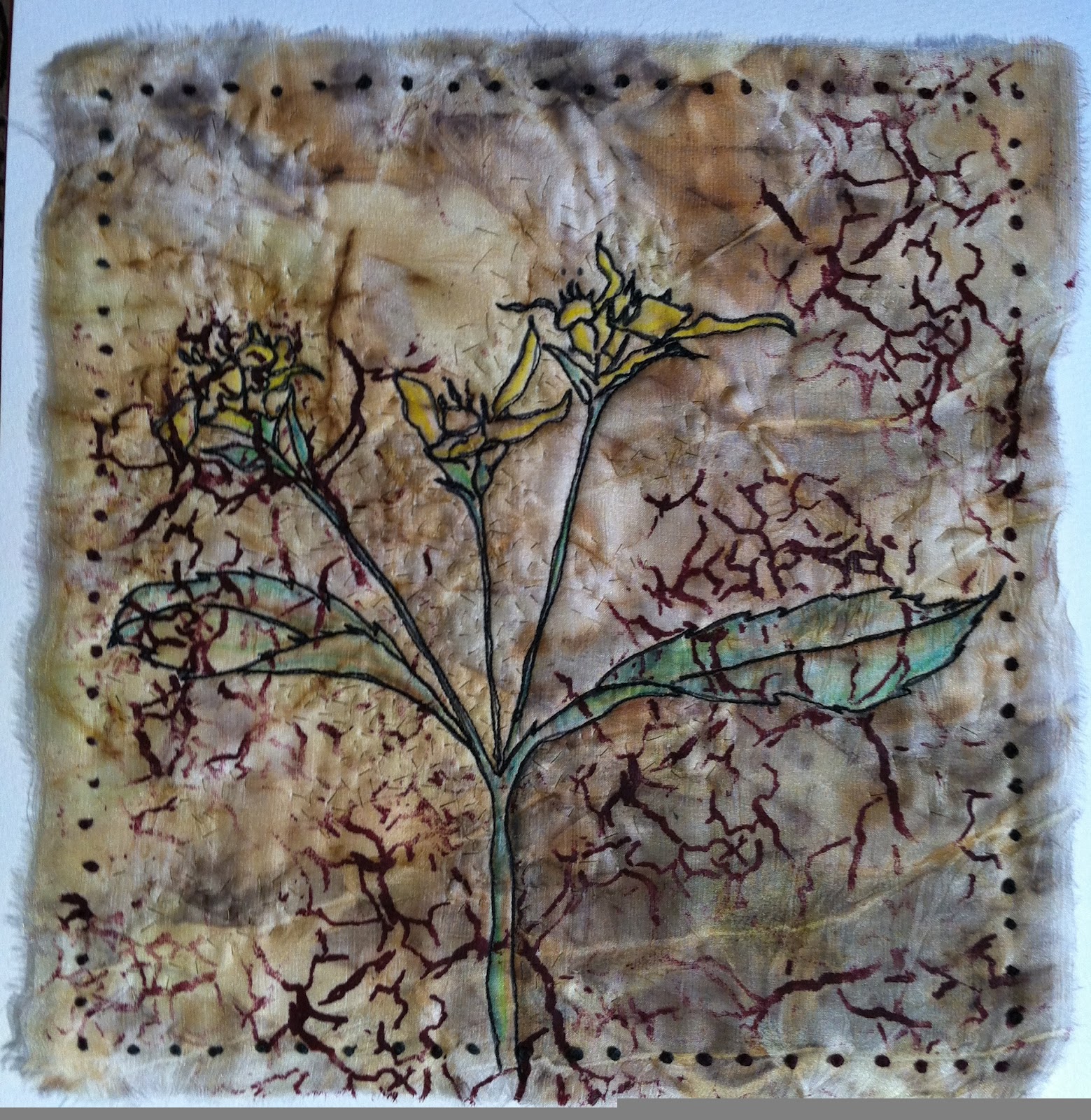
Verbisina Occidentalis by Lyric Kinard
Each artist in the group has been paired with a writer and set free to work on a collaborative work. The lovely and talented poet, Maura High, is my partner and I couldn't have asked for a better person to work with. We've connected well and are working on a sort of "call and response" series. I respond to her poem with art - she responds to that work with another poem - and so on.

Verbisina Occidentalis by Lyric Kinard
I chose a poem of hers that seemed to grab me on a visceral level - and that brought such immediate visuals to my mind that I couldn't shake it. I didn't intend to be so literal with the piece but, well, there you go. Hmmm. It's rather odd - but in looking at all the pictures I like this one best. A simple sketch with needle and thread.

Verbisina Occidentalis by Lyric Kinard

Verbisina Occidentalis by Lyric Kinard

Verbisina Occidentalis by Lyric Kinard

Verbisina Occidentalis by Lyric Kinard

VERBESINA OCCIDENTALIS
Dark does not fall: it rises from the soil, 
seeping along the flattened grass 
of the dim path and flowing 
up trees already black, 
night’s conduits, forked
darkening against the retreating light,
while below them in the field the crownbeard 
on its winged stem makes a last effort, 
waggling its two or three 
yellow rays, lifting 
its small cluster of disc petals
in imitation of the sun—though
its leaves have gone quiet already, 
and the pollinators sleep their insect sleep.
*
Sleep is just a way to talk about what happens 
in the dark, what the cells do, what 
color green is, when no light shines on it.
The crownbeard holds still now, nothing moves
under the streetlights in the ramifying subdivisions.
Wings close, and petals. Eyes 
see nothing that is not inward and radical. 
There are boundaries, such as where stem
becomes root, and where the taproot probes 
among stones, and we may travel them, 
through capillaries and waterways and geographies 
of decomposition. Underground is like aboveground
inverted, a reflection of sorts, uncertain
and hopeful as seedheads at seedtime.
*
Seedtime is the wind, and seeds 
quiver in their bracts, as brittle 
as moths are, and as dry, as poised, 
as these winged stems, which still lean 
to the light. One good shake 
and they scatter down the grasses 
and lodge: while the rains come, and long hours 
of dark and cold, while they parse 
moonlight and sunlight, and know already 
that the root comes first and follows water
down the kingdoms of soil, then a tendril 
and the precursors of leaves, leaf, branch and crown.
I hold some in my palm: each husk ribbed and shaped
like a vase, like the word promise in their language.
*
In their language, grow is a conversation among cells,
why, thank you, here’s the sun! you go first, 
yes, you, I this way and in this green vein
upward, and here’s sap, sweet and mineral . . .
Like banners held to our view
by attending angels, their pronouncements
unfurl and flutter through the daylight, 
and all night they hum. The point being seed
and more seed, up there where their lures dangle;
a few long, bright yellow petals, no need 
for more when bees enough roam the flowerets,
when even one person has leaned closer, as if to listen
and instead been sounded, like a drum
struck and reverberating through the field and further.
*
And further afield, along trails 
mapping the wood, waysides, and how many lives
did I pass through and never know its name? 
By hearsay and looking, in a book, I found 
a paradise of leaves, opposite and ovate,
that curious “tissue decurrent on the stem,”
the loose corymbs, taxonomies of desire 
in a right name, a promise 
of knowledge and belonging, as in “my flower,” 
“my field,” and so on, until “our flower,”
our dominion. That much was in my gift—a sprig, 
it’s true. While the flowers, which know all about 
belonging, heeded the imperatives of light and wind, 
water calling to them: Verbesina, little word.  
*
Word, made dicotyledon and vascular, 
one-stemmed perennial aster, of the family 
Asteraceae: not so much star as a constellation
of particulars, a coming-together that was years
in the making. I saw crownbeard growing, 
yellow crownbeard, Southern crownbeard, 
here, in an old field reverting to wood.
Birds fidgeted in the stands. Deer 
crashed through the stiff, ribbed stems 
and left them bruised and flattened. People
and their dogs passed through, Linnaeus 
and his descendants were among the familiars.
We left traces in the air, on the grass
and track, a faint phosphorescence in the dark.
© Maura High
Nov 2011–Jan 2012

Thursday, February 16, 2012

I Love ... Simple Kindnesses

It's often very small things that bring joy to my life.

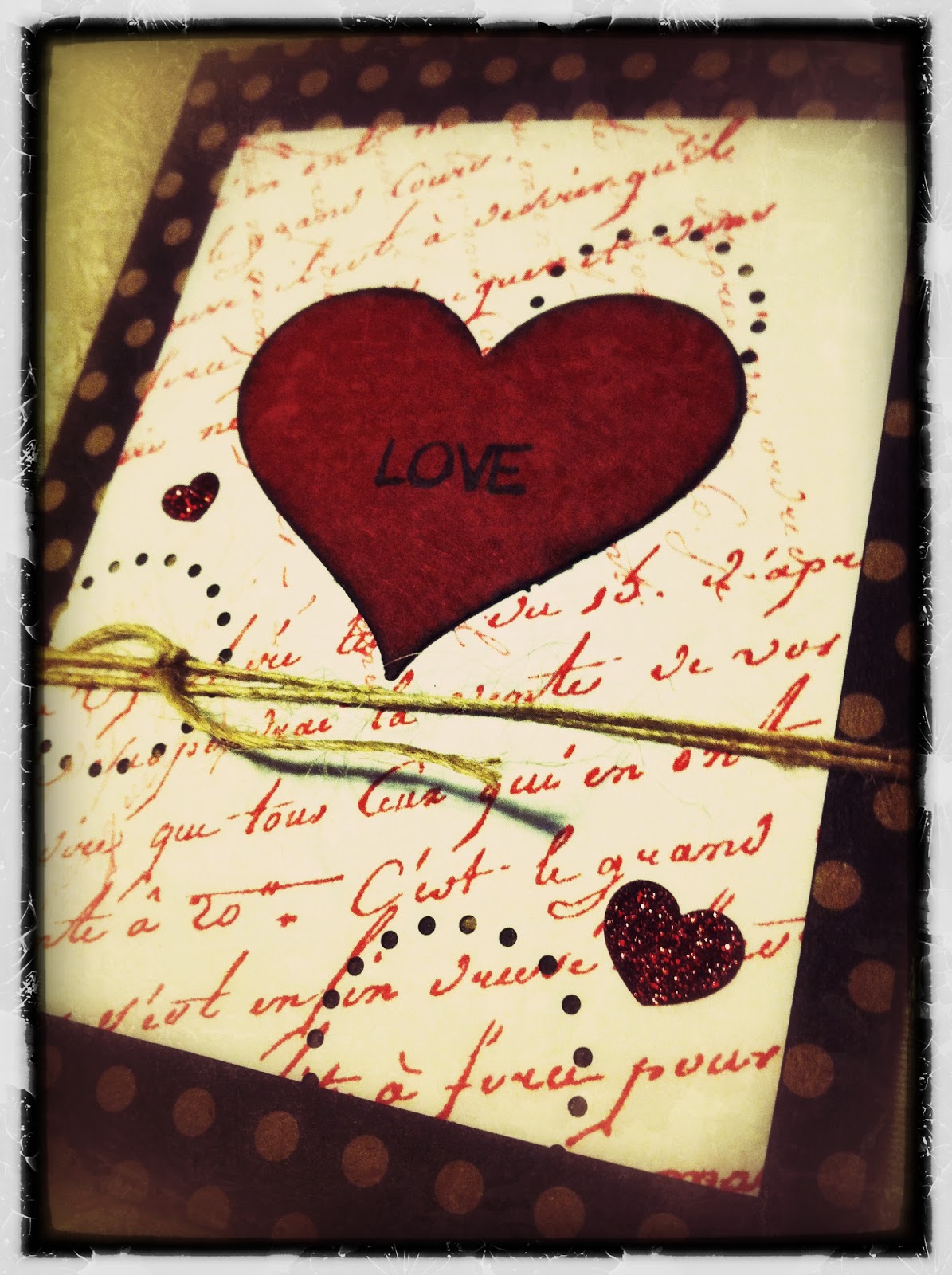
Valentine by MaryAnne Durr

For instance - the people in my neighborhood wave to each other as they drive by. I haven't seen it out and about in my town and it didn't happen in the neighborhood we lived in before this. But it happens on the streets where I live. It makes me happy.

Postcard by Hannah Koch

On a day when I received two rejection letters from art shows I also received this beautiful piece of art in the mail, a postcard with a little thank you note on the back from the lovely and talented Hannah.

When one of my children says "thank you" for a task that is usually invisible it makes me just go all twittery and happy. Smiles make me happy. Surely I can return the favor and perform some simple kindness for the world. Yesterday I bought a bouquet, took out one flower at a time and handed them to everyone I saw until the ran out. With a smile and a "Happy Valentine's Day". It went well this time.

What SIMPLE KINDNESS will you give to the world today?

Wednesday, February 15, 2012

Creative Wisdom from Pixar's John Lasseter 3 of 7

John Lasseter’s 7 Points (by way of Scribble Junkies)
3. Quality is a great business plan. Period.
“There is a crucial rule: no compromises. No compromises on quality – regardless of production constraints, cost constraints, or a deadline. If you get a better idea, and this means that you have to start again from scratch, then that’s what you have to do.
In any creative industry, quality is the sole business plan that prevails in the long run. Many managers fail to understand that, but the spectators understand it. The process is only finished once the creative professional in charge says it’s finished. That does not mean that there isn’t to be any pressure – there’s pressure all the time anyway – but the individual creator always needs to have the last word.”


How this might relate to my career as an artist?
Don't settle for less than my best effort.

Now you know by now that I'm firmly in favor of making BAD ART!
I do not, however, send BAD ART out into the world.
BAD ART is a necessary stepping stone into the wonderful world of GREAT ART! The bad stuff is just a way to let yourself go, to freely play with new ideas and spark creative juices and let them flow in unexpected directions. 

When it comes time to settle down and work on the good stuff - do the best you possibly can.
Strive for excellence in your technique, beauty in your composition, quality in your craftsmanship and just plain DO YOUR BEST. 
(yes, I was a cub scout den mother, thank you very much)

What areas of your art need work?

Sunday, February 12, 2012

I Love ... On-Line Students!

May I tell you how much I love my on-line students? The Artist's Toolbox (new session opens this friday) is an especially wonderful class for me to get to know these lovely people. 

Angela - value study
So many of them come in saying "I can't draw" or have real reservations about their abilities to create original art but by the end of class you see their confidence just blossom. 

Dahlia - depth study
 I truly DO believe that everyone is creative in some way.
If you give yourself time to learn and permission to be imperfect it is amazing what you can do.

Cindy - shape study
 Art CAN be taught. You can learn to draw through some simple steps and exercises if you are willing to put in the effort. You CAN learn to understand the basic elements and principles of design. 

Uliday - texture study
 If you want to be and artist, if you are willing to put in the time and the effort....
YOU CAN BE AN ARTIST!

Lorelei - movement study
I'd love to share the journey with you. I feel an attachment with each one of these students.
Join me for
four lessons, $36.00 beginning
February 17, 2012

Yes ... I'm shamelessly begging.

(but it's for a good cause)

(update: you all are absolutely amazing. I do mean AMAZING! Both kidlets have surpassed their goals and are very excited to send out some fun drawings. They've got their work cut out for them. Thank you, thank you, thank you! From the bottom of our healthy hearts - the the hearts of those you've helped to survive - we thank you.)

Could you do me a GREAT BIG favor? 

My little ones are doing a fundraiser for the American Heart Association. They are raising money through a jump-a-thon at school for children who need heart surgery.

If you have a minute could you click on each link and help them out? Even one dollar will help. Their deadline is coming up TOMORROW and the only one who has donated is me and one of you amazingly kind readers. They've been drawing valentine pictures to send out to their sponsors but they don't have any (other than me) yet. If you donate then reply here with your address we'll mail you a delightful piece of their original art.


Saturday, February 11, 2012

Creative Wisdom from Pixar's John Lasseter 2 of 7

John Lasseter’s 7 Points (by way of Scribble Junkies)
2. Remember the first laugh.
“A big problem in the creative process is related to the enhancement of your ideas. Revising, retouching, refining is very important, but it carries a danger. If you have a story, a joke, a thought, which you write down, it loses its effect over time. It wears itself out. When you hear a joke for the second time you still laugh heartily, on the third or fourth occasion already less so, and when you hear it the hundredth time, you hate it.”
“I say to my authors: ‘Take notice of the first laugh, write it down if necessary. This may at times be bothersome, but it is important. Many times, good things got lost because people could not remember anymore how it felt when they heard the idea for the first time.”

To me this means keep your ideas fresh. 
How? It's probably different for every artist.
I keep a sketchbook.
  • Write down all of your thoughts and ideas and inspirations.
  • Journal a bit to capture your thought processes.
  • Include test samples for when you are trying out new techniques.


When you get too close to a piece you're working on, gain some distance.

  • Put it away for a day or two - there is an art fairy that visits at night an makes things look good again.
  • Put it on the wall, walk as far away as you can before turning to view it.
  • Turn the piece upside down or look at in in a mirror.
  • Go back to your sketchbook and remember what it was you loved about it at the beginning.
How do you keep your ideas fresh?